The Beginner’s Guide to Organization
This post may contain affiliate links which means I make a commission if you shop through my links.
Disclosure Policy
Feeling overwhelmed by clutter, this Beginner’s Guide to Organization is a good place to start.
Have you ever noticed that when you run into someone that you haven’t seen for awhile and ask how they have been – the answer is usually “I’ve been busy.”
Life is busy.
That is because we have:
- too much to do,
- too much information to consume,
- too much stuff to manage,
- people that need our time, and
- lots of things that we really want to get to.
By trying to do it all we end up wasting precious time that we can never get back. The 24 hours that we have in each day is finite. We can’t make more hours. But we can improve the way that we use the time we have. We can free up our time by living a more organized life.
The formula for living a more organized life is pretty basic. It’s all about creating systems that make your life easier, calmer, and more intentional.
Whether you’re drowning in paperwork, struggling to keep your home tidy, or simply tired of feeling behind, this guide will walk you through the step by step organizing process that I use with my clients. I also include ideas for different rooms in your home.
If you are in a hurry and just want to get started, bookmark this post for later and head over these 9 organizing tips that you can use to jump start your decluttering process.
What Is Organization?
Most people think of organization as putting things away or decluttering your home or workspace. But this is a misconception.
Having a neat and tidy home is a welcome side effect of organizing, but it is actually not the goal. In fact, some people that have an outwardly messy house, are actually pretty organized.
We have all heard the phrase: “A place for everything, and everything in it’s place.” This is what we are striving to achieve.
If we have habits, routines, and systems for managing all the things in our home or workplace, we not only end up freeing up mental space and physical space, we also free up the time we would normally spend on figuring out what to do with all our stuff. And, believe it or not, the time we spend on making those mundane decisions really adds up.
At it’s core, living a more organized life is not about putting your stuff away, it is about improving your personal productivity because your ultimate goal is to free up more time.
Read about what organizing really means here.
Why Getting Organized Feels Hard
If you’ve ever thought “I’m just not an organized person,” you’re not alone. The truth is, organization feels hard because:
- You have too much stuff
- You don’t have systems
- You’re trying to do everything at once
- You’re waiting for motivation instead of building habits
- You’re overwhelmed and don’t know where to start
Marie Kondo, in her book The Life Changing Magic of Tidying Up, tells us that getting organized is all about your mind-set, and I have to agree. Before you get started setting up even one system, project, or process, you have to show up with a can-do attitude.
I go over 10 ways to establish an organizing mind-set in this post. It is a good one to review before you dive into any big project, just so you are aware of obstacles and emotions that may get in the way as you organize.
The good news is that once you create a plan to get started, it does get easier.
Focus On One Area At A Time
You can divide your life into 4 main areas that need to be organized and require your attention:
- Time
- Space
- Information
- People
If you are trying to deal with everything at the same time, it can be tricky because you will veer off track. If you’ve ever set a goal to clean off your desk (space) and then found yourself immersed in paperwork (information), you know what I mean.
This guide deals mostly with number 2 – organizing your space. You can find detailed plans for managing the other areas in our Featured Guides section.
The Core Principles of Organization
To get started, let’s talk about these 5 core principles of organization. This strategy applies to whatever you are trying to organize (your home, paperwork, computer, workplace, etc.). You can see how I applied the process to organizing my linen closet here.
1. Declutter
The first (and most important) step to getting organized is decluttering. You want to get rid of things that you don’t want or need.
We often feel that we don’t have enough space in our homes because we are hanging on to stuff that is not necessary.
Yet, this is also the hardest phase in the organizing process because we are emotionally tied to our things even if we don’t use them.
The easiest way to start is to get rid of the obvious things – items that are broken or expired, clothes that don’t fit or are out of style, and things that you haven’t used in ages and have no attachment to.
Then you can move on to more sentimental items that are harder to part with.
The book called The Life Changing Magic of Tidying Up by Marie Kondo is a great resource to help with decluttering and one of my favorite reads about organizing. It might sound corny, but she advises you to pick up each object and ask yourself “if it brings you joy”. Truly, things that don’t make you happy (aside from the necessities of life) are not space worthy. This process can really help you declutter memorablia.
You can find it alongside my other favorite titles on my virtual Organizing Bookshelf here. And you can also read my book review here.
2. Give Everything a Home
Once you have finished the decluttering step, it is time to figure out where to put the things you have decided to keep.
The biggest mistake that I see here is choosing to store items in a very inconvenient location. People tend to gravitate towards putting things where they fit instead of where they are actually used.
A prime example of this often happens when organizing the kitchen and I have even fallen into this trap. The drawers and cabinets around your stove should contain items that you use for cooking – things like cooking sized utensils and pots and pans. But for years, I stored a cookie press in the drawer next to my range top because it fit well in that space.
Do you know how often I use a cookie press? Maybe once a year, if even that. Here I was sacrificing prime kitchen real estate for an item I rarely used.
So, at this stage, take some time to think about how you use the items you are keeping and create a plan of where to store them that is in close proximity to the place where they will be used.
3. Choose Containers and Storage Bins Wisely
At this point you may notice that choosing storage bins is not number one on the list. Resist the urge to run out and buy cute, Pinterest worthy storage bins first thing.
Once you have created your plan for where to store things you can decide on what type of storage is going to work best.
Take your time, make note of any measurements, and do your research to find just the right bins, baskets, and boxes.
One factor to consider, especially if you want a uniform look, is availability – because you may need to add more at a later time.
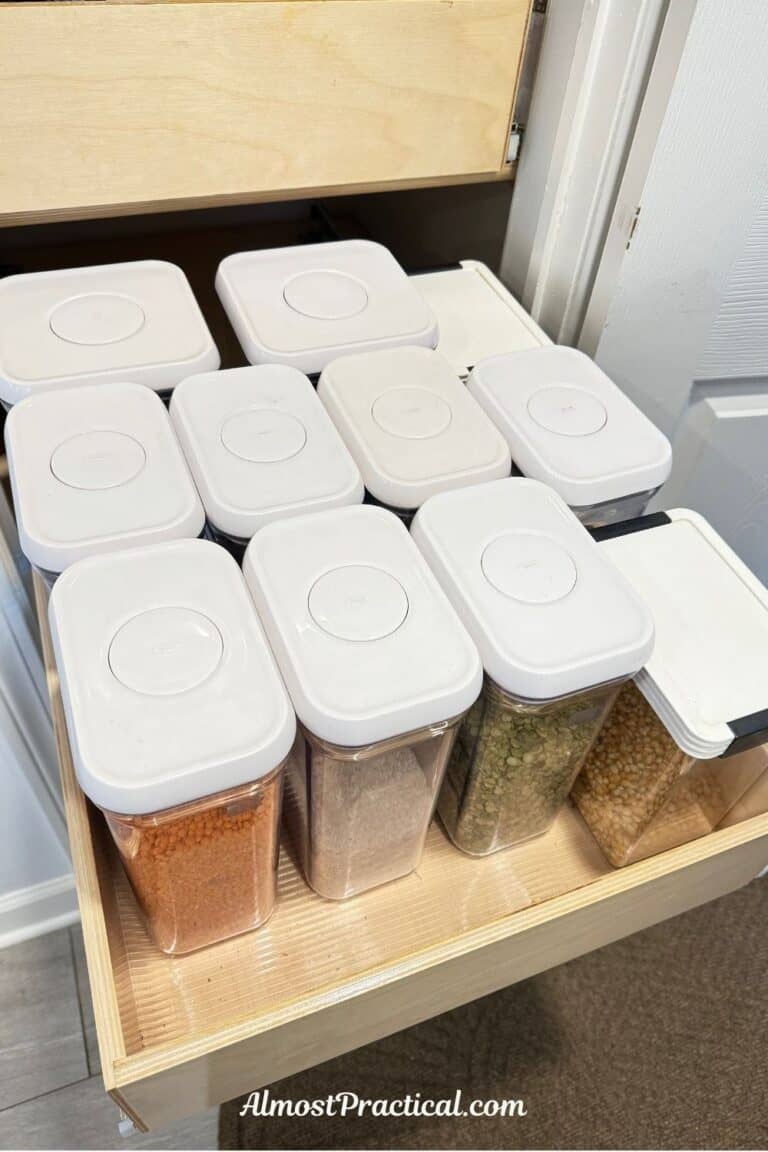
And another thing that is important to me is whether the bin is clear or not. Overall, I prefer clear bins, especially in closed closets, so I can see what is inside. It makes it easier for me to find things when I need them.
But if you have an open shelf you may go for something like a basket to hide what is inside which will make the room feel neat and less cluttered.
In The Life Changing Magic of Tidying Up, Marie Kondo advocates using things like box lids and other makeshift containers you have lying around the house to use as drawer dividers. This is a great and economical way to get organized by reusing or recycling what you already own.
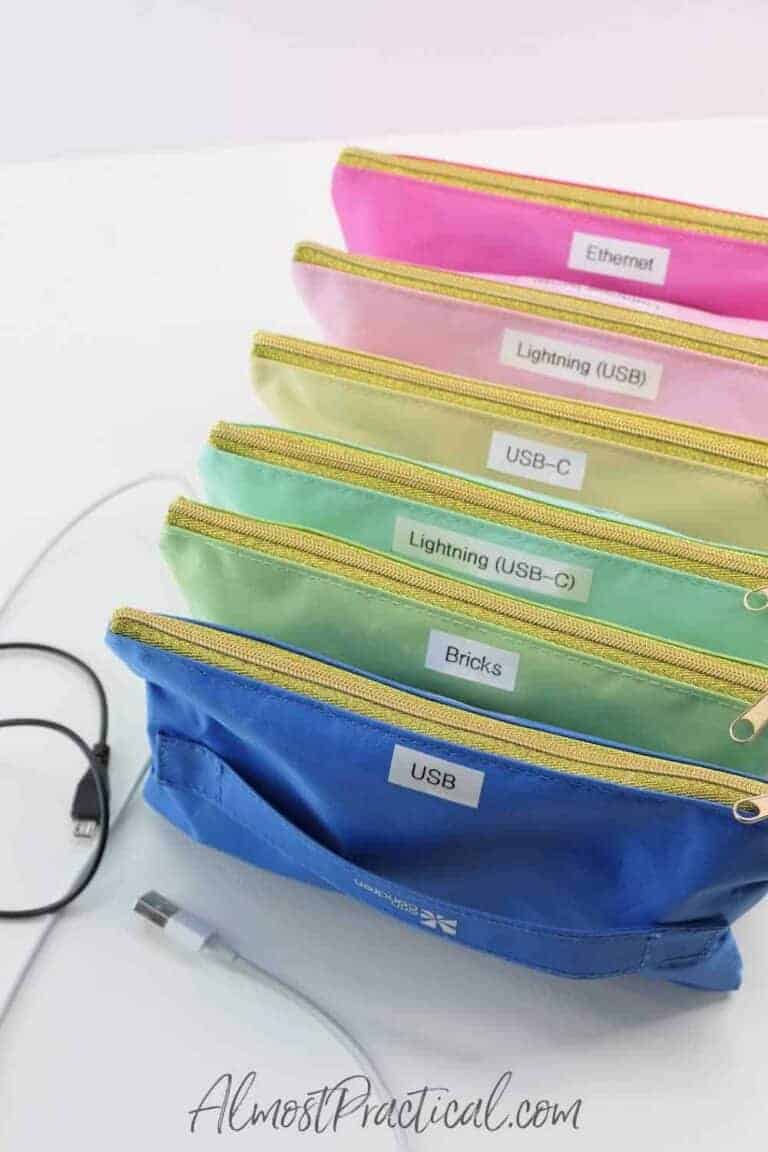
4. Label Everything
Whether your storage bins are see-through or not, labeling can be a big timesaver. It saves you a lot of effort when you are looking for something.
Ironically, we tend not to label because it takes too much effort! Another downside is that sometimes the contents of our bins change and the labels become inaccurate.
The key to labeling is to be as generic or as specific as needed to keep the label relevant.
For example, for cooking spices you will be very specific with your labels. Sage, marjoram, thyme all look the same to the untrained eye, so you want to specifically identify the contents.
But for something like Christmas decorations, you can make your label more general. You can simply label a box with “Ornaments” and not drill down to the specific porcelain ball you acquired in Italy.
There are many ways to create labels. You can simply use a permanent marker, a sticky note, and some tape.
Or for something more uniform in appearance, you can use a label maker like this one.
For fancier labeling you can create labels using removable or permanent vinyl on your Cricut cutting machine. You may have thought it was just for crafts, but I use mine more for organizing.
5. Implement, Revisit and Revise
Organization isn’t a one time project, it is always a work in process. Be sure to set aside time on a weekly basis to put stray items away, assess if your system is working, and revise accordingly.
If you are having a hard time keeping things neat, you need to get down to root cause and fix what isn’t working.
Personally, I had an issue crop up with where I stored small household tools like screwdrivers and measuring tape. We have a standalone toolbox in the garage where we keep our hardware items. It is organized well and it’s easy navigate. But it is not portable and whenever I needed a tool, I would have to grab a collection of items, bring them into the house, then go back to the garage and sort them back into their designated spots in the toolbox. What I found is that I would procrastinate on small household fixes because I did not have time to go to the garage and go through this process.
So, I revised and adjusted and ended up creating a small caddy with a collection of a few basic tools that I stored in a hallway closet. Whenever I needed a tool, I could grab this caddy and take it to whatever room I was working in. This worked like a charm. For bigger projects, I still need to visit the garage toolbox but for everyday tightening and tweaks my caddy works great!
How to Start Organizing When You’re Overwhelmed
Tunneling through the overwhelm is the biggest barrier to getting started with organization. Sometimes the mess just seems like too much. So, where do you begin?
My advice is always to pick your biggest pain point and start there. If you deal with whatever is causing you the most frustration you make room in your mental space to tackle the next thing.
For more in depth ideas check out our guide called Where to Start Organizing When You Feel Overwhelmed here.
Start Small
One small success will lead to another, so instead of taking on a large room like your kitchen, for instance, organize the junk drawer instead.
Look at your schedule and figure out how much time you have to devote to organizing. If you only have an hour, pick an area that you can reasonably complete in that hour.
You want to set yourself up for success.
Use the “Empty, Sort, Decide” Method
Working through the principles of organization that I outlined above:
- empty out the area (drawer, cabinet, closet, etc) that you are organizing,
- sort through the items,
- discard what you don’t need or want,
- replace things that belong in that space, and
- relocate things that don’t.
Room by Room Organization Basics
Thus far we have talked about organization in general terms. So, now I will give you some more specific ideas for different rooms in your home and for common areas that need to be put back into order.
Organizing the Kitchen
In addition to personal productivity, my specialties are kitchens and home offices because these are the most used rooms in a home.
For families, a kitchen is the central hub of the home. And it can get cluttered very quickly.
In this busy space, you want to make sure that the tools you need for cooking are readily available and that your countertops are free from clutter so you actually have space to prepare meals.
To do this, consider creating a drop zone in a different space in your home so things like backpacks, purses, keys, and mail don’t end up on your counters.
Bedrooms and Closets
As far as storage goes, we use our bedrooms to mostly store clothing. And clothing has a way of multiplying quickly.
Organize clothing in your closets by category: pants, dresses, short sleeve tops, long sleeve, etc.
Make sure that you have plenty of hangers and skip the cheap wire hangers. I prefer a mix of velvet hangers for silky material that tends to slip off plastic hangers and plastic hangers for materials that cling too much to velvet.
If you don’t have a lot of closet space, store your off season clothing separtely in bins in a different location in your home (basement, attic, or under the bed).
Keep the surfaces of dressers and nightstands free of clutter.
Bathroom Organization
Go through your drawers and medicine cabinets and toss expired toiletries and medications.
Use plastic bins under your sink for storing things you use regularly.
If many people use the same bathroom (my four children shared one bath when they were growing up), consider getting each person a caddy for their personal toiletries that they can take back to their room and store in their own closets. This will free up limited drawer and counter space in the bathroom.
Home Office Organization
Create a system for handling your paperwork and incoming mail. Ideally, you want to clear off your desk at the end of each day so you are ready to dive into your work when you sit down the next day.
Use a paper shredder and immediately shred things like unwanted credit card offers and bank statements you no longer need.
Better yet, scan and digitize items to reduce papers.
Digital Organization Strategies
This brings us to the black hole that is our computer or cloud based storage. Scanning and digitizing will clear up your physical home office but now your computer or cloud drive is taking in that clutter. And you need to keep this organized to so you can find the things that you need.
Here are some ideas for the bigger problem areas:
- Email – unsubscribe, designate a specific folder for downloads, and create folders to store important emails outside of your inbox.
- Files and Folders – create a naming convention and a structure so that you can easily file and find important documents
- Photos – cleaning up old photos is a long term project, but if you can set aside some time each week to organize your new photos you can ensure that you are not adding to the chaos
- Passwords – button this down and pick a safe and reliable password manager
- Your computer desktop – keep this empty and only use it for the project files that you are currently working on. Just like your physical desk, try to clean it off at the end of each day.
Tips for Organizing Success
I have covered a lot of ground in this Beginner’s Guide to Organization and my number one tip is to just get started.
If you are feeling overwhelmed, start small. Pick something you can complete in the time you have available and choose an area that is really causing you frustration.
When you have finished an area, allocate time each week to maintain your system and tweak as needed and don’t allow yourself any distractions during this time.
Also, to avoid bringing new clutter into the house, be sure to use what you already have before buying something new!
The Last Thing You Need to Know About Getting Organized
Getting organized is all about the journey, not the destination.
We are always buying new things and purging old.
This requires us to rethink how we use our space on a continuous basis.
It’s always going to be a work in progress so take your time and don’t put too much pressure on yourself.
Happy organizing!